Hannah Morris (Education Studies and Special and Inclusive Needs, School of Education)
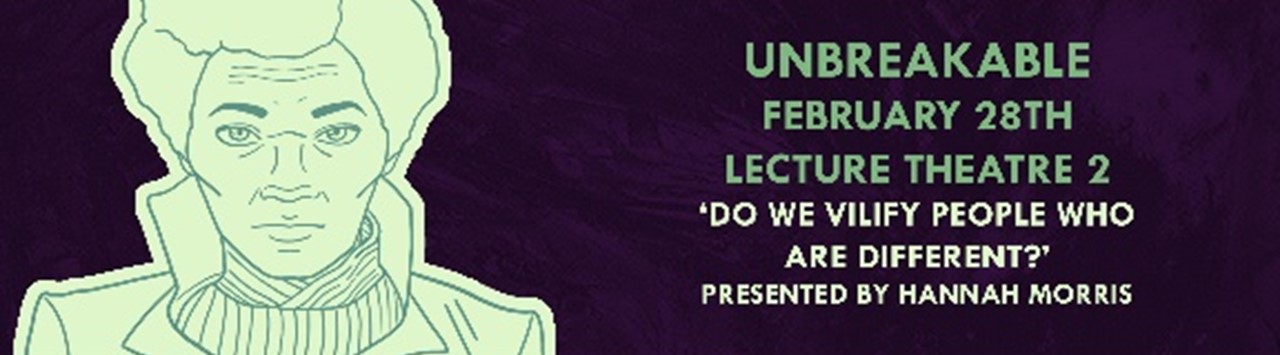
I was the first student intern to present a Dis/Ability on Screen film seminar featuring a character with disabilities. The film I selected was Unbreakable by Manoj Nelliyattu, or ‘M. Night’, Shyamalan. The film was well received and provoked plenty of discussion amongst the audience present at its screening. Most audience members thought that the inclusion of a disabled character was a conscious decision and handled sensitively enough so as not to be offensive.
Released on the 23rd of December 2000 (IMDb, n.d.), Unbreakable focuses on the lives of David Dunn and Elijah Price. Dunn, played by Bruce Willis, is a security guard who survives a horrific train crash, killing everyone onboard, with no injuries (Bradshaw, 2000).The main character I focused on was Elijah Price, played by Samuel L Jackson. He was born in 1961, with Osteogenesis Imperfecta, also known as Brittle Bone Syndrome. Brittle Bone Syndrome, according to the NHS website, is where fractures are caused by minimal impact due to a lack of collagen, which is the protein ‘responsible for bone structure’ (NHS, 2019). The film closely follows Elijah and how he believes that his physical impairment and Dunn’s invulnerability are signs that they are connected (Cineworld, n.d). The reason I chose this film is because so far it has not been the subject of much academic research and its characters have admirable depth. The Guardian film critic Peter Bradshaw in 2000 stated that M. Night Shyamalan is a remarkable film-maker and that in every sense his films are to be considered ‘deeply strange’ (Bradshaw, 2000). Unbreakable is known for creating a mood or ‘atmosphere’ because of different themes explored; for example, the mood is tense when Elijah tells a customer to leave his art shop, as he feels insulted by the suggestion that comic books are ‘childish’.
The main question guiding my seminar was: ‘Do we vilify people who are different?’. I chose this question because I wanted to explore the relationships that were established involving the villain character with a disability, Elijah. More particularly, I was interested in analysing to what extent Elijah was positioned as a villain because of his actions or by his condition.
There are several relationships that feature prominently in the film. Elijah’s disability in the film helps to create a familial and nurturing relationship with his mother, who was his main carer throughout his childhood. One of the audience members watching the film felt that the attention devoted to this mother-son relationship made Elijah seem more like a child rather than an adult with a disability. However, another audience member suggested the relation between mother and son was more about kindness than about infantilising. Bill Hughes has argued that disabled people are often positioned as requiring sympathy from others, which affects disabled people’s senses of self (Hughes, 2002). His views support the point made by the first audience member, namely: that the character of Elijah, through his disability, is at times used to generate pity. In other words, Elijah seems to be viewed differently from the rest of the characters precisely because of his disability. Another common stereotype in the media is that of the ‘super cripple’ (Barnes, 1992; Harnett, 2000), which implies that if a disabled person performs an ordinary task, they should be praised for it. This is prominent in the scene where Elijah receives a comic book as a reward for going outside as a child on a playground presenting numerous risks in view of his disability. The reward for being brave enough to go outside, which is, of course, a fairly common task for able-bodied characters, affirms the ‘super-cripple’ stereotype.
When discussing camera angles and colours highlighting the connection between David and Elijah, a member of the audience described how Elijah only ever wore clothes in the colour purple and David only wore green- or grey-coloured clothing. The main purpose of this use of colour was to express that David as a hero wearing green was connected in some way to Elijah, an eccentric villain as evident from his obsession with the colour purple (Acuna, 2019). Members of the audience suggested that the use of colour in this way was a ‘comic book’ style, with purple having been used to show villains such as the Joker and Magneto, and remarked that the colours green and purple were intertwined as they were constantly made to appear together. This supported by Totaro, who points to one scene, in David’s house, where on the green wardrobe there appeared a purple mirror (Totaro, 2003). This suggests M. Night Shyamalan uses the two colours together as a forewarning of a future relationship. One audience member noted that the longest camera shots of the whole film are those introducing the characters, for instance, the opening shot following Dunn on a train about to derail and crash. This scene in fact contains nine single shots together making up the longest shot of the film (Totaro, 2003). It is also the scene where Elijah’s bones break whilst being born, and this indicates how the characters are opposites, for example, Elijah being born with a ‘weak’ body and David having supernatural strength.
I asked the audience attending the film screening how we are positioned to feel about Elijah, to which one audience member responded that we were made to like the character because of his charisma and his ability to deal with a ‘debilitating’ disability. However, another audience member disputed this point, saying that throughout the film it was hinted at Elijah being evil. Barnes (1992) has inferred that people with disabilities have often been portrayed as being sinister or evil. This may link back to medieval times, where people with disabilities were thought to have disabilities because God punished them for previous sins committed, the link with sin implying they themselves were evil (Tracey, 2013). One audience member argued that the film may vilify him for being different; for example, he has a severe disability which causes him to be so sinister. However, another audience member suggested that the film tries to make us feel sympathetic towards Elijah and almost justify his actions. In my opinion, this may be seen in the scene where Elijah falls down the stairs because he was trying to prove to David that he has a gift for sensing danger. It seems, at the time, that Elijah is trying to help David realise his potential and mentor him to be the best superhero he can be, and as he fell down the stairs he felt punished for attempting to do something good.
To conclude, there was much debate about the film and Elijah’s disability. Some felt Elijah’s disability contributed to his committing of evil acts, but others thought that it did not in itself explain, let alone excuse, his actions. It is worth considering that positioning Elijah’s disability as the reason for his actions may help vilify other people who have the same condition. One audience member felt that Elijah was vilified for being different, as he was excluded as a child due to his disability. Most of the audience thought that Elijah’s actions were the reason he was vilified and that his murdering of civilians could not be brought back to his condition. The audience seemed to agree that Shyamalan used Brittle Bone Syndrome to help create a complete opposition to David. However, some may argue it is important to remain conscious about tastefully or accurately representing people with disabilities in the media; Haller (2010) in this context stresses that some people do not have ample balanced personal experience with ‘disability’. Therefore, one may argue Unbreakable vilifies people who have Brittle Bone Syndrome, for some people may only ever encounter the condition through the film and may assume that everyone with such a disability bears a grudge against able-bodied people. The film also constitutes a commentary on how we view disabled people, as Elijah has a physical disability but is far more intelligent than David, as evident from his organising of several high-profile mass killings as well as manipulating David throughout the film. Ultimately, this raises questions about what defines someone as ‘able’ and qualifies another as ‘disabled’, that is: about the unstable relationship embedded within the very concept of disability.
References
Acuna, K. (2019) 12 Details you Probably Missed in ‘Unbreakable’ and ‘Split’ that Hint at the Plot of ‘Glass’. Business Insider Australia. [online] Available at: https://www.businessinsider.com.au/unbreakable-split-references-to-glass-2019-1 [Accessed 10 May 2019].
Barnes, C. (1992) Disabling Imagery and the Media: An Exploration of the Principles for Media Representations of Disabled People. Halifax: British Council of Organizations of Disabled People.
Bradshaw, P. (2000) Unbreakable. The Guardian. [online]. Available at: https://www.theguardian.com/film/2000/dec/29/culture.peterbradshaw [Accessed 11 May 2019].
Cineworld.co.uk. (n.d.) 6 Important Scenes from M. Night Shyamalan’s Unbreakable to Prepare you for Glass. [online] Available at: https://www.cineworld.co.uk/blog/six-scenes-from-unbreakable-to-prepare-you-for-glass [Accessed 25 February 2019].
Haller, B.A. (2010) Representing Disability in an Ableist World: Essays on Mass Media. Louisville, KY: Avocado Press.
Hartnett, A. (2000) Escaping the ‘Evil avenger’ and the ‘Supercrip’: Images of Disability in Popular Television. Irish Communication Review, 8(1): 21-29.
Hughes, B. (2002) Bauman’s Strangers: Impairment and the Invalidation of Disabled People in Modern and Post-Modern Cultures.Disability & Society, 17(5): 571-584.
IMDb. (n.d.). Unbreakable (2000) – IMDb. [online] Available at: https://www.imdb.com/title/tt0217869/ [Accessed 5 June 2019].
NHS (2019) Osteogenesis Imperfecta. [online] Available at: https://www.gosh.nhs.uk/conditions-and-treatments/conditions-we-treat/osteogenesis-imperfecta [Accessed 5 June 2019].
Totaro, D. (2003) Visual Style in M. Night Shyamalan’s ‘Fantastic’ Trilogy: The Long Take. Offscreen.com. [online] Available at: https://offscreen.com/view/shyamalan#fn-1-a [Accessed 12 May 2019].
Tracey, E. (2013) Disability History Month: Unpacking Medieval Myths. BBC News.[online] Available at: https://www.bbc.co.uk/news/blogs-ouch-25188538 [Accessed 7 June 2019].
 Dis/Ability on Screen